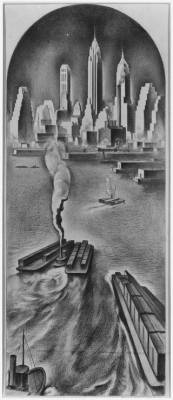
Skyscrapers Louis Lozowick Precisionism School of Art New York
Beginnings and Development

It is not articulate who starting time coined the term Precisionism. It may take been Charles Sheeler, one of the movement'southward foremost painters, or, as seems well-nigh likely, Alfred H. Barr, the start director of the Museum of Mod Art in New York Urban center, in 1927. In other sources, art historian Wolfgang Born is credited with the first use of the term when he applied it in 1947, while others claim that it was not until 1960, when the Walker Art Center in Minneapolis mounted "The Precisionist View in American Art" exhibition, that the motility was officially recognized. Whatever the original source of the term, its practitioners attracted the early on support of patrons including Charles Daniel (owner of the Daniel Gallery), Stephen Conservative (the Conservative Gallery), Alfred Stieglitz (the 291 Gallery, Intimate Gallery and An American Identify), Gertrude Vanderbilt Whitney (the Whitney Studio Social club) and, moving into the 1930s, the Whitney Museum of American Art.
The challenge for historians is that Precisionism was never a formal school or motility, one supported, perhaps, by a published manifesto. It was, rather, a philosophical outlook shared past several American painters and photographers during the early decades of the twentieth century. The group - who have been referred to variously equally "Cubist-Realists", "Immaculates", "Sterilists" and "Modern Classicists" - shared an interest in jubilant the dynamism of the modern industrial America and conveyed this aspect of modernity through precise lines and pared back geometric forms. The fundamental Precisionists have been identified (in no order of preference) as Sheeler, George Ault, Ralston Crawford, Francis Criss, Charles Demuth, Preston Dickinson, Elsie Driggs, Louis Lozowick, Gerald White potato, Georgia O'Keeffe, Niles Spencer, Morton Schamberg, Joseph Stella, Alfred Stieglitz and Paul Strand.
Early Encounters with Modernism

Probably the most influential unmarried figure in introducing European modernism to American audiences was the lensman, publisher and gallery possessor Alfred Stieglitz. A pioneer of mod photography himself, Stieglitz, with his friend and colleague Edward Steichen, established the 291 Gallery in New York which operated betwixt 1905 and 1917. Stieglitz's goal was to elevate photography to the same status as painting and sculpture and his gallery became not only an exhibition home for the then-chosen "Photo-Secession Group", but as well the state'southward beginning exhibition space for imported works by European avant-garde artists such as Henri Matisse, Henri Rousseau, Pablo Picasso, Auguste Rodin, Paul Cézanne, Marcel Duchamp and Francis Picabia.
Yet, it was through the International Exhibition of Modern Art (known every bit the Armory Show since information technology was staged in vast Usa National Guard armouries) of 1913 that appear Fauvism, Cubism and Futurism to the wider populous. The Armory Bear witness would prove a landmark event in American art history and provided the goad for American artists who wanted to create their very ain artistic linguistic communication. Stieglitz said the challenge now facing domestic artists was to establish a national art motility that represented "America without that damned French flavor!".
Some other significant figure in introducing European modernism to America was Walter Arensberg who became a major collector of modern art after the Arsenal Evidence. Walter, and his wife, Louise, became close friends with Duchamp who they set up up in a studio apartment on New York'due south 67th Street. Walter even collaborated with Duchamp on "assisted readymades" such equally Comb and With Subconscious Noise (both 1916). In the 1920s, the Arensbergs moved from New York to Los Angeles, taking with them works past Duchamp, Picabia, Rousseau, Braque and Matisse and transforming their home in that location into a veritable West Declension Salon.
The Birth of Precisionism
Every bit early as 1915 Preston Dickinson was producing European-inspired works that focused on industrial subjects such as factories and granaries. Nearly of his industrial scenes were, even so, drawn from his imagination. Charles Sheeler turned to Precisionism in 1917, two years before his motion from Philadelphia to New York. Sheeler'southward favourite subject was barns, reduced to cuboid masses and surface textures, with all references to the natural setting within which the building stood omitted. "In these paintings I sought to reduce natural forms to the borderline of brainchild, retaining simply those forms which I believed to be indispensable to the pattern of the picture", Sheeler said. In 1923 the art critic Forbes Watson placed Sheeler within a tradition of American production: "in the clean-cut fineness, the cool austerity, the complete distrust of superfluities which nosotros find in some pieces of early American furniture, I seem to see the American root of Sheeler's art". Sheeler also enjoyed a long and successful career as a lensman. In 1921 he had collaborated with the Directly lensman Paul Strand on the film Manhatta, based on quotations from Walt Whitman, and celebrating New York as an architectural phenomenon. Sheeler's photographs also provided blueprints for paintings, combining abrupt-focus photographic-like detail with tight abstruse cohesion.
Charles Demuth - who in his earlier career had excelled as a watercolorist of still-life florals, a volume illustrator, a playwright and writer of curt prose pieces for avant-garde journals - had emerged out of a "Cezanne-esque" stage of painting to create cityscapes of churches and factories which were more tightly constructed in a Precisionist manner that borrowed from the Futurists and German language-American Expressionist Lyonel Feininger. Demuth was fascinated past grain elevators, water towers, and mill chimneys, although he neither wholly accepted nor disapproved of industrialization. He was also interested in advertising hoardings on buildings and along highways. "America doesn't really care" nearly art he wrote to Stieglitz. "Still, if one is really an artist and at the same time an American, merely this not caring, even though it drives one mad, tin be artistic fabric".
The Maturation of Precisionism
During the 1920s many of the Precisionists exhibited at the Charles Daniel Gallery in New York. When information technology airtight in 1932, Edith Halpert's Downtown Gallery became the primary showcase for Precisionism. Exterior a dedicated gallery infinite, the group featured in The Little Review'due south Auto Age Exposition held at the Steinway Hall, New York in the leap of 1927. This event brought together paintings, architectural drawings and photography. Encouraged by Duchamp, Jane Heap - the celebrated publisher who, with Margaret Anderson, edited the famous modernist literary journal (The Little Review) - organised the show at which Sheeler, Demuth and Louis Lozowick all participated and served on the Artists' Lath.
Writing in the catalogue, Lozowick expressed the belief that America was going toward an "gild and organization which found their outward sign and symbol in the rigid geometry of the American metropolis: in the verticals of its smokestacks, in the parallels of its car tracks, the squares of its streets, the cubes of its factories, the arc of its bridges, the cylinders of its gas tanks". Lozowick added that "the history of America is a history of gigantic engineering feats and colossal mechanical constructions [...] The skyscrapers of New York, the grain elevators of Minneapolis, the steel mills of Pittsburgh [...] give the American cultural epic its diapason". Lozowick implored American artists, finally, to celebrate this "underlying mathematical pattern".
Concepts and Trends
Architectural Structure

Precisionism started from the position that all ornamental embellishments should be stripped away and the search for the pure architectural structure should be the focus of aesthetic attending. While self-consciously identifying equally Americans, the influence of the European avant-garde is clear and the Precisionists were emboldened to pursue abstract forms, fracture compositions and skew perspective, and to stand for the world both perceptually and conceptually.
Drawing predominantly on Cubist and Futurist compositional ideas, and ofttimes marrying these pictorial techniques with those derived from photography, the Precisionist artists sometimes strove to present multiple views of a bailiwick, and even stand for differences in fourth dimension and place. Precisionist style was linear, hard edged and brittle. The presence of brushstrokes conveying how the paint was applied was absent, seemingly suggesting that the human being is redundant, perchance even absent. Critic Alexander Adams wrote, "Precisionist fine art speaks of perfectionism, attempts to impose control over external chaos and hypersensitivity towards disruption. It is a pathological response akin to phobia of germs or insecurity in the face of change. Precisionism is the fine art of those averse to imprecision; information technology speaks of fear of decay and worry about ambiguity and dubiety".
Mechanization

Taking mechanization as subject matter was a reflection of America'south investment in progress, its faith in science and engineering, and its positive belief in the virtues of manufacture. Simply Precisionist paintings gave rising in certain circles to an ambivalent mental attitude toward mechanization. Many paintings endow factory and industrial buildings with a kind of monumentality reserved previously for the depiction of churches. Others, however, hint at the dehumanising effect of engineering science and, with a lack of human presence in the works, the absence of a soul at the eye of modernity. Sheeler often applied his attention to detail to transform mundane objects into transcendent subjects worthy of worship. But The New York Daily Worker commented with a tone of derision that "Sheeler approaches the industrial landscape [...] with the same sort of piety Fra Angelico used toward angels [...] In revealing the dazzler of mill architecture, Sheeler has become the Raphael of the Fords".
Photography

The interests of modern photography and Precisionist painting often overlapped in the 1920s. Paul Strand (a one-time inferior mentee of Stieglitz) had taken his ain inspiration from the paintings of Cezanne, Braque and Picasso and became fixated on the idea that the photographic image could besides exist broken upward compositionally. His initiated the idea of Straight Photography which used large format cameras to create loftier contrasts (rather than shading), flat, or two-dimensional images, semi-abstractions, and forms of geometric repetition. Stieglitz had been then impressed with Strand's artistic maturation that he himself adopted Strand'southward Direct Photography aesthetic. In 1917 Stieglitz gave Strand a major exhibition at his 291 Gallery then allotted two problems of his photography magazine Camera Work entirely to Strand'south work.
Through Stieglitz'southward promotion, the idea of Directly Photography impacted upon the fashion that Precisionists focussed in on the world, peculiarly in the geometric realism of Sheeler, Demuth and Stella. Sheeler was himself an accomplished commercial photographer and often based his paintings on his photographs. He also employed photographic techniques such as flattened and bowed perspective in some of his painted works. In 1921, Strand and Sheeler collaborated on a brusque, silent motion-picture show called Manhatta (AKA: New York the Magnificent). The moving-picture show, which captured the move of everyday street life under the architectural shadows of the looming New York skyline, reflected many of Precisionism'due south aesthetic preoccupations and is widely considered to be the first American avant-garde picture.
Later Developments - After Precisionism

Past the late 1930s, the U.s.a. was providing refuge for artists and architects fleeing fascist Europe. Many of them had been schooled in the Bauhaus tradition which sought unity between art and technology. Bauhaus and Constructivist influences merged with the Precisionist fascination for geometric and architectural forms, which became fifty-fifty more focussed on shape, pattern, and texture. By the 1940s, however, Precisionism's major champions had either passed abroad, fallen out of fashion, or moved on artistically. Charles Demuth died aged 51 in 1935, having finished a serial of seven paintings depicting factory buildings in Lancaster, Pennsylvania. Sheeler stayed true to his Precisionist principles, merely focussed increasingly on photography. Precisionism's influence continued to be directly felt, in a more dour and unsettling mode, in the American Scene Paintings of Charles Burchfield, George Ault and Edward Hopper, the latter becoming the accepted master of pocket-sized boondocks alienation.
History indicates that Precisionism was a span between realism and a more modernistic American vision, with Abstruse Expressionism building upon Precisionism'southward reductionism simply past rooting itself more in the subconscious explorations of Surrealism. As collector Deedee Wigmore observed, "Precisionism was well-nigh the search for architectural structure underlying reality, which eventually led American artists out of realism into pure geometric abstraction". Precisionism's impact on advertising imagery and phase and fix design, meanwhile, continued throughout the twentieth century, inspiring countless cinematographic visions of bucolic America too.
Perchance its most straight influence was felt, however, past Popular artists such as Jasper Johns and Robert Indiana, and especially in their "numbers paintings". The art historian Eli Anapur writes for instance that ane painting - Demuth's I Saw the Figure Five in Gold - "holds the foremost place in this equation of significance" for twentieth century American art and argued "its pop subject and angled forms anticipate both Pop and Abstract art". She writes that both movements "slowly emerged from the increased stylization of forms and reduction of details", but it was in fact "Demuth'south affiche-portraits - specific in their depictions of letters and everyday commercial objects instead of figures [that] are some of the primeval examples of such imagery in American Fine art" and these directly "inspired similar Pop Art renderings of consumer objects".
Source: https://www.theartstory.org/movement/precisionism/history-and-concepts/
0 Response to "Skyscrapers Louis Lozowick Precisionism School of Art New York"
Enregistrer un commentaire