What Makes an Art Object ââåauthenticã¢ââ to a Particular Culture?

Authenticity in art is manifest in the different ways that a piece of work of art, or an artistic performance, can be considered authentic.[one] The initial distinction is between nominal authenticity and expressive authenticity. In the offset sense, nominal authenticity is the correct identification of the author of a work of art; of how closely an actor or an actress interprets a role in a stageplay as written by the playwright; of how well a musician'southward performance of an artistic composition corresponds to the composer's intention; and how closely an objet d'fine art conforms to the creative traditions of its genre. In the second sense, expressive actuality is how much the work of art possesses inherent dominance of and most its field of study, and how much of the artist'southward intent is in the work of art.[2]
For the spectator, the listener, and the viewer, the authenticity of experience is an emotion impossible to recapture beyond the get-go encounter with the work of art in its original setting. In the cases of sculpture and of painting, the contemporary visitor to a museum encounters the work of art displayed in a simulacrum of the original setting for which the artist created the fine art. To that end, the museum visitor will meet a curated presentation of the work of art as an objet d'art, and might not perceive the aesthetic experience inherent to observing the work of art in its original setting — the intent of the artist.[three]
Artistic actuality is a requirement for the inscription of an artwork to the World Heritage List of the Educational, Scientific, and Cultural Organisation of the Un (UNESCO);[4] the Nara Document on Actuality (1994) stipulates that artistic authenticity tin can be expressed through the class and design; the materials and substance; the employ and role; the traditions and techniques; the location and setting; and the spirit and feeling of the given piece of work of art.[5] [six]
Nominal authenticity [edit]
Provenance [edit]
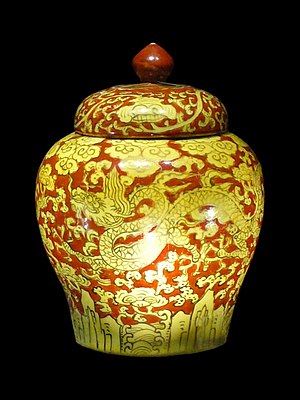
Authenticity of provenance: The Xanthous Dragon jar from the Jiajing period (1521–1567) of the Ming dynasty (1368–1644); a practical detail in the 16th-century, and an objet d'art in the 21st century.
The authenticity of provenance of an objet d'art is the positive identification of the artist and the place and time of the artwork'southward origin;[7] thus, art experts make up one's mind authenticity of provenance with four tests: (i) verification of the creative person'due south signature on the piece of work of art; (two) a review of the historical documentation attesting to the history of the artefact; (three) scientific bear witness (x-rays of the sail, infrared spectroscopy of the paint, dendrochronological analysis of the woods); and (iv) the expert judgement of a connoisseur with a trained eye.[8]
In Sincerity and Actuality (1972), the literary critic Lionel Trilling said that the question of authenticity of provenance had caused a profoundly moral dimension, that regardless of the physical condition and appearance, the quality of workmanship of an artwork, information technology is greatly of import to know whether or non a Ming vase is authentic or a clever art forgery.[nine] The preoccupation with the actuality of provenance of an artwork is historically contempo, and detail to Western materialism; in the Eastern world, it is the piece of work of fine art, itself, which is important; the artist's identity and the provenance of the artwork are secondary considerations.[10]
Fine art forgery [edit]

The art of forgery: The Supper at Emmaus (1937), by Han van Meegeren, a Dutch master forger who deceived the Nazi leader H. Göring that the painting was a genuine Vermeer painting.
Consequent to a critically truncated career, the painter Han van Meegeren (1889–1947) earned his living as an art forger, past specifically producing false paintings by 17th-century artists, such equally Frans Hals (1582–1666) and Pieter de Hooch (1629–1684), Gerard ter Borch (1617–1681) and Johannes Vermeer (1632–1675). Van Meegeren produced masterly paintings that deceived critics and fine art experts, who then accepted and acclaimed the forgeries equally genuine masterpieces, especially the Supper at Emmaus (1937) painting accepted as a real Vermeer past experts, such as Abraham Bredius.
In the upshot, to survive the 2d World War (1939–1945), van Meegeren dealt forgeries to the Nazi occupiers of kingdom of the netherlands (1940–1945). In the post–State of war reckoning among the nation, the Dutch authorities arrested van Meegeren as a Nazi collaborator who had sold national treasures to the enemy. To avoid a traitor'south death, the painter van Meegeren showed his artistic skills equally a forger of paintings by the Old Masters, to prove he sold forgeries to the Nazis.[11]
To guard confronting unwittingly ownership a forged work of art, sellers and buyers apply a document of actuality every bit documentary proof that an artwork is the genuine creation of the creative person identified equally the writer of the work — nonetheless at that place is much business organisation in counterfeit certificates of authenticity, which determines the monetary value of a work of art.[12] Certificates of authenticity can be obtained in a variety of ways, a mutual 1 includes authentication past an art expert. Notwithstanding, art experts are not infallible, and in that location are complications when the authentication techniques go tied with personal interests. The inauthenticity of forged painting is discovered with documentary evidence from art history and with forensic evidence gleaned from the techniques of fine art conservation,[13] such as chronological dating, to found the actuality of provenance of paintings by the Old Masters.[xiv] [xv] The potential budgetary value represented by a document of authenticity can prejudice collectors and art dealers to purchase recent-period artworks with adamant provenance, sometimes established by the artist.[16]
Forgery as fine art [edit]
Critical interest in a forgery as a work of art is rare;[17] yet, in the essay "The Perfect Fake" (1961), the critic of architecture and art Aline B. Saarinen asked what "If a fake is so expert, that fifty-fifty later on the nearly thorough and trustworthy examination, its actuality is still open up to doubt, is it or is it not as satisfactory a work of fine art every bit if information technology were unequivocally genuine?"[eighteen] In The Act of Creation (1964), Arthur Koestler concurred with Saarinen's proposition of "forgery as an art", and said that if a forgery fits into the body of work of an artist, and if the forgery produces the same aesthetic pleasure as the authentic artworks, then the forged art should be included to exhibitions of the works of the plagiarised artist.[19]
In the fine art business, the artistic value of a well-executed forgery is irrelevant to a curator concerned with the actuality of provenance of the original work of fine art[20] — specially considering formally establishing the provenance of a work of art is a question of possibility and probability, rarely of certainty, unless the artist vouches for the authenticity of the art.[21] Even so, to the arts community, a forgery remains a forgery, regardless of the first-class creative execution of the forgery, itself; regardless of the artistic talent of the forger; and regardless of critical praise when critics and public believed the forgery was authentic fine art.[17]
Mechanical reproduction [edit]

Mechanical reproduction of art: Facsimile of a 1611 woodcut of the Renaissance French composer Josquin des Prez (1450–1521) copied from an oil painting, the authentic work of art.[22]
Relief printing is a course of mechanical reproduction of art; thus (i) an artist created a drawing; (2) a craftsman used the cartoon to create a woodcut block for relief-press, ordinarily destroying the original artwork when cutting the drawing into the block of wood; and (iii) the woodblock, itself, was discarded when worn-out for relief printing copies of the drawing. From that three-step process for the production of art, the printed copies of the original cartoon are the final product of artistic creation, nevertheless there exists no authentic work of art; the artistic copies have no authenticity of provenance.[23]
In the essay "The Work of Fine art in the Age of Mechanical Reproduction" (1935), Walter Benjamin discussed the then-new visual media of photography and cinematography as machines capable of producing art that can exist reproduced many times — yet no one version of the image is the original, artistically authentic image. As visual media that reproduce — but do not create — original images, photography and the cinema shift the concept of artistic authenticity from "art every bit ritual" to "fine art as politics" and so brand works of art accessible to the mass population, rather than just the addict.[24]
A contemporary extension of Benjamin'due south observations is the perpetual authenticity of the sculpture Sunbather (1971), by the artist Duane Hanson (1925–1996), who gave permission to the conservators of the life-sized sculpture (a woman sunbathing whilst reclining in a chaise longue) to supersede parts of the sculpture (cap, swimming arrange, towel, etc.) that became faded and worn.[25] Likewise, in light of the artistic production and mechanical reproduction capabilities of computers and the internet, the media artist Julian H. Scaff said that the authenticity of provenance of a digital image (painting, still photo, cinema frame) cannot be determined, because a digital work of fine art usually exists in more one version, and each version is not created, but authored by a different digital creative person with a unlike perspective of what is art.[26]
Authenticity of experience [edit]

The authenticity of experience of a work of art is ephemeral; thus, beholding the statue of the Hindu goddess Tara (Sri Lanka, eighth c.) in a secular setting (a museum) is unlike the artful feel of beholding the statue-equally-goddess in the original setting (a temple).
Authenticity of experience is available just to the spectator who experiences a work of art in the original setting for which the artist created the artefact. In another setting, the authenticity of experience (purpose, time, place) is impossible; thus, in the Western globe, the museum brandish is an approximation (literal, metaphoric) of the original setting for the which the artist created the piece of work of fine art. Isolated exhibition in a museum diminishes the aesthetic experience of a work of art, although the spectator will see the work of art. Lacking the original context (place, time, purpose ) limits artful appreciation than experience of the work of art in the original setting — where the fine art and the setting are the artful intent of the artist.
Recognizing that authenticity of feel is unique and cannot be recaptured, the curator of a museum presents works of art in literal and metaphoric displays that approximate the original settings for which the artists created the artworks. Realised with artifice and lighting, the museum displays provide the spectator a sensory feel of the works of fine art.[3] In that commercial vein, the bout business sells "the feel of fine art" as a facsimile of the authenticity of experience of fine art. The tourist consumes "Culture" by attending an opera at La Scala, an 18th-century opera firm at Milano. The natural audience, informed opera aficionados, lose interest and cease attention regularly, but the opera house is a business concern, and continues presenting performances for aficionados of civilization and for tourists with, perhaps, an agreement of the opera — the art beingness experienced. As well, to earn a living every bit artists, Pacific Islander dancers present their "Pacific Islander culture" as entertainment for and edification of tourists. Although the performances of Pacific-islander native culture might be nominally authentic fine art, in the sense of being true to the original culture, the actuality of experience of the art is questionable.[2]
Cultural authenticity [edit]

Cultural authenticity: An Haitian Vodou fetish statue of a devil with twelve eyes.

Cultural authenticity: A carved-wood bulul is a stylized representation of an ancestor that gains power from the presence of an ancestral spirit. Dating from the 15th century, bulul figurines guarded the community'south rice ingather, feature in traditional ceremonies, and are souvenirs sold to tourists to the Philippine Islands.
The actuality of provenance establishes the material existence of the work of art; the identity of the artist; and when and where the artist created the piece of work of art. Cultural authenticity — genre and creative style — concerns whether or not a work of fine art is a genuine expression of creative tradition. Concern with the cultural actuality of a work of art usually originates from romanticism about the greater artistic value of artefacts created in "the pure tradition" of the genre; such an idealistic perspective ordinarily derives from nationalism and racism and tribalism, and misunderstandings of aesthetics.[27]
A piece of work of art is authentic when executed in the manner, with the materials, and by the production procedure that are essential attributes of the genre. Cultural authenticity derives from the artistic traditions created by the artists of the ethnic grouping. A genre artwork is authentic just if created by an artist from the ethnic group; therefore, simply the Inuit people can create authentic Inuit art. The philosophic and sociologic perspective of the actuality of expression is what protects artists from the art thefts inherent and consequent to cultural appropriation; nonetheless, in the essay "Race, Ethnicity, Expressive Actuality: Can White People Sing the Blues?" Joel Rudinow disagreed and defended cultural cribbing, and said that such protectiveness of cultural actuality is a form of racism.[28]
The art business [edit]
In the Westward, the market for "primitive art" arose and developed at the cease of the 19th century, consequent to European explorers and colonialists meeting and trading with the cultural and ethnic groups of Africa, Asia, and Oceania. Artistically, the native peoples who dealt with the explorers and colonists quickly incorporated to their production of art new materials from Europe, such equally cloth and glass beads. Yet European collectors and art dealers would non purchase "inauthentic", mixed-media primitive art made with native and European materials. To overcome resistance to inauthentic primitive fine art, the art dealers produced artefacts, made with local materials, which Westerners would accept and buy as authentic native art.[29]
The 19th-century business organization model of artistic production remains the contemporary practise in selling authentic objets d'art to Western collectors and aficionados. Usually, the artefacts are designed and modified to give the impression of possessing popular attributes and authentic provenance, such every bit religious-ritual utilize, antiquity, and association with aristocracy and royalty.[thirty] In the 20th century, during the 1940s, Haitian artists created commercial reproductions of "voodoo images" provided to them by foreign businessmen, to sell as "authentic voodoo art." To the Haitian artists, the foreign representations of Haitian artistic civilization, which they were paid to brand, demonstrated the fine art-theft inherent to cultural appropriation and how White foreigners truly saw Haitian Vodou fine art as a commercial commodity, and non every bit religious art.[31]
Deities and souvenirs [edit]
To distinguish a work of fine art from a crude artefact fabricated for tourists, art collectors consider an artwork to be artistically authentic when it meets recognised standards of artistic production (design, materials, manufacture) for an original purpose. In the Philippine Islands, throughout their history, the Igorot people have used carved-forest bulul figurines to baby-sit the rice ingather; the bulul is a highly stylized representation of an ancestor that gains power from the presence of an bequeathed spirit.[32]
Although still used in traditional ceremonies, the Igorot people at present produce gift bulul figurines for tourists; a secondary purpose that does not devalue the bulul as art. Within the culture, an Igorot family might employ a gift bulul equally suitable and acceptable for traditional ceremonies — thereby granting the gift bulul an artistic and cultural actuality otherwise absent.[two] From that perspective, "tribal masks and sculptures" actually used in religious ceremonies take greater commodity value, especially if authenticity of provenance determines that a native artist created the artefact past using traditional designs, materials, and production techniques. Such Western over-valuation of native art is predicated by the artefact being an authentic instance of a tradition or style of fine art practised by a primitive people.[33]
Invented traditions [edit]
The artistic evolution of the Maroon people of French Guiana, shows that contemporary artistic styles developed through the interaction of art and commerce, betwixt artists and art businessmen. The long history and stiff traditions of Maroon art are notable in the forms of ornamentation of everyday objects, such as boat paddles and window shutters, art of entirely artful purpose. To sell Maroon artworks, European fine art collectors assigned symbolism to the "native art" they sold in the art markets, to collectors, and to museums; a specific provenance. Despite the mutual miscommunication betwixt artists and businessmen about the purpose, value, and cost of works of fine art, Maroon artists used the European semiotic linguistic communication to assign symbolic meanings to their works of native art, and make a living; notwithstanding immature Maroon artists might mistakenly believe that the (commercial) symbolism derives from bequeathed traditions, rather than from the art business.[34]
Expressive authenticity [edit]

The singer Tina Turner and the guitarist Eric Clapton are known for the expressive authenticity of their arts, rather than authenticity of tradition.
Authenticity of expression derives from the work of art possessing the original and inherent dominance of the artist's intent, that the work is an original product of aesthetic expression. In musical performance, authenticity of expression can conflict with authenticity of performance when the operation of the musician or the vocalist is true to his or her artistry, and is not an imitation of some other artist.[2] The greater popularity of the performer, rather than of the composer of the song and the music, is an historically contempo evolution that reflects the public's greater involvement in the expressive authenticity of charismatic musicians who possess a distinctive artistic style.[35]
In the fields of art and of aesthetics, the term expressive authenticity derives from the psychological term Actuality, as used in existential philosophy, regarding mental health as a person's self-noesis most his or her relation to the real globe.[36] In that vein, the creative product of Abstract Expressionists, such as Jackson Pollock (1912–1956), Arshile Gorky (1904–1948)), and Willem de Kooning (1904–1997), take been understood in existentialist terms about the artists' relation with and to the earth; likewise the cinematic art of the cinéastes Jean-Luc Godard and Ingmar Bergman (1904–1997).[37]
Expressive authenticity derives from the creative person'due south authenticity of way and tradition, thus an outsider's appropriation of voice is disallowed because the cultural group already have native artists producing authentic fine art.[38] In the American music business, the Hip hop genre originally was musical art created past poor Black people to accost their discontents almost the poverty, ignorance, and racism imposed upon them in American society. Artists debate if Hip hop's profitable transition from the artistic underground to the commercial mainstream has voided the authenticity of expression of the music.[39] In "Actuality Within Hip Hop and Other Cultures Threatened with Assimilation", the bookish Kembrew McLeod said that the cultural actuality of Hip hop is threatened by absorption into the music business, where commercialism replaces expressive authenticity.[forty]
Authenticity of functioning [edit]

Authenticity of operation: A Baroque music ensemble playing Baroque menstruum instruments, using period techniques, whilst dressed in contemporary garb.
In the theatre and in music, the performers (actors, actresses, musicians) are responsible for realising a performance of the corresponding piece of work of art, a stageplay, a musical concert. An historically informed operation of a play by Shakespeare, the women characters would be portrayed past actors, not actresses, every bit was the custom in the Elizabethan era (1558–1603) and the dialogue would be enunciated and pronounced in the Elizabethan way of speech.[two] In an historically informed performance, the actors and the musicians replicate the time period of the piece of work of fine art they are performing, ordinarily by way of period-right language and costumes and styles of performance and musical instruments. The musicians would consider inauthentic any functioning of the Elvira Madigan piano concerto that the pianist played on a contemporary grand pianoforte, an musical instrument unknown to the composer W.A. Mozart (1756–1791).[two]
Authenticity in Crypto art [edit]
Emerging as a niche genre of artistic work following the evolution of blockchain networks such as Bitcoin in the mid to late 2010s, crypto art rapidly grew in popularity in large part considering of the unprecedented ability afforded by the underlying engineering science for purely digital artworks to be bought, sold, or nerveless.[41] Artists such as Beeple use blockchain every bit a response to the art world'southward need for authentication and provenance in an increasingly digital world, permanently linking a digital file to its creator.[42] However, some crypto artists such equally José Delbo and Hackatao have been criticised for possible infringement of copyrights.[43] The crypto fine art world, however, enable artists to secure the anonymity of their identity.[44] [45] Some advocates of crypto fine art note that the authentication of NFTs allows for art collecting to be made public for anyone to meet in a form that is resistant to forgery, as all provenance within the traditional art world is siloed and not public.[46] [47]
Meet also [edit]
- Appropriation (fine art)
- Hallmark
- Actuality (philosophy)
- Auteur theory
- Simulated document
- Folklore
- Forgery
- Plagiarism
- Selling out
- Stuckism
- Tradition
References [edit]
- ^ Davies, Higgins & Hopkins 2009, p. 156.
- ^ a b c d eastward f Dutton 2003, pp. 258ff.
- ^ a b Phillips 1997, pp. ane–4.
- ^ UNESCO 2011, pp. 21f.
- ^ Larsen 1995.
- ^ Larsen 1994.
- ^ Potter 2010, p. 78.
- ^ Potter 2010, p. 86.
- ^ Potter 2010, p. 9.
- ^ Abbing 2002, p. 110.
- ^ Potter 2010, p. 85.
- ^ Potter 2010, p. 87.
- ^ "Hallmark in Art".
- ^ Fleming 1975, p. 567.
- ^ Charney, Noah (15 November 2017). "Christie's da Vinci Sale Reveals Why Forgers Love to Fake Masters". Observer . Retrieved 2017-11-xvi .
- ^ McAndrew 2010, p. 56.
- ^ a b Schefold 2002.
- ^ Goodman 1976, p. 99.
- ^ Koestler 1964, pp. 400ff.
- ^ Goodman 1976, p. 119.
- ^ McGowan 2000, p. 230.
- ^ Macey 2010.
- ^ Hind 1935, pp. 88ff.
- ^ Benjamin 1936.
- ^ Spencer 2004, p. 129.
- ^ Scaff.
- ^ Bendix 1997, pp. 6ff.
- ^ Coleman 2005, pp. 31ff.
- ^ Scharfstein 2009, pp. 99–100.
- ^ Carrier 2005, p. 281.
- ^ Richman 2008, p. 203.
- ^ Dyrness, Kärkkäinen & Martinez 2008, p. 64.
- ^ van der Grijp 2009, p. 317.
- ^ Price 2007.
- ^ Abbing 2002, p. 173.
- ^ Wood et al.
- ^ Crowell 2010.
- ^ Potter 2010, pp. 79ff.
- ^ Rose 1994, pp. 39–forty.
- ^ McLeod 1999.
- ^ "How blockchain engineering reached Christie'south and inverse the fine art world along the fashion". NBC News . Retrieved 2021-05-25 .
- ^ Thaddeus-Johns, Josie (24 February 2021). "Beeple Brings Crypto to Christie's". The New York Times. ISSN 0362-4331. Retrieved 2021-05-25 .
- ^ "Who tin sell a Wonder Woman NFT? The guy who drew her or DC Comics?". Los Angeles Times. 14 April 2021. Archived from the original on 2021-04-xiv. Retrieved 2021-05-25 .
- ^ "Crypto artists have been building a rebellious, hole-and-corner community of outsiders for years. Now they're making a living selling NFTs". Washington Post. ISSN 0190-8286. Retrieved 2021-05-25 .
- ^ Crow, Kelly (21 April 2021). "Who Is Pak? The Artist's Fans Couldn't Care Less". Wall Street Journal. ISSN 0099-9660. Retrieved 2021-05-25 .
- ^ Kessler, Andy (23 May 2021). "Opinion | Mark Cuban Knows Crypto". Wall Street Journal. ISSN 0099-9660. Retrieved 2021-05-25 .
- ^ Contributors, Publisher Guest. "How Non-Fungible Tokens are Revolutionizing the Art World". www.nasdaq.com . Retrieved 2021-05-25 .
Sources [edit]
- Abbing, Hans (2002). Why are artists poor?: the exceptional economy of the arts. Amsterdam Academy Press. ISBN90-5356-565-v.
- Baaz, Maria Eriksson; Palmberg, Mai (2001). "Questioning 'Authenticity': The Case of Gimmicky Zimbabwean Stone Sculpture". Same and other: negotiating African identity in cultural production. Nordic Africa Institute. ISBN91-7106-477-X.
- Bendix, Regina (1997). In search of authenticity: the formation of folklore studies. Univ of Wisconsin Press. ISBN0-299-15540-4.
- Benjamin, Walter (1936). "The Work of Art in the Historic period of Mechanical Reproduction".
- Carrier, James G. (2005). A handbook of economic anthropology. Edward Elgar Publishing. ISBN1-84376-175-0.
- Coleman, Elizabeth Burns (2005). Ancient art, identity and appropriation. Ashgate Publishing, Ltd. ISBN0-7546-4403-0.
- Crowell, Steven (2010). "Existentialism". In Edward N. Zalta (ed.). The Stanford Encyclopedia of Philosophy (Winter 2010 Edition).
- Davies, Stephen; Higgins, Kathleen Marie; Hopkins, Robert (2009). "authenticity and fine art". A Companion to Aesthetics. John Wiley and Sons. ISBN978-1-4051-6922-vi.
- Dyrness, William A.; Kärkkäinen, Veli-Matti; Martinez, Juan Francisco (2008). Global Dictionary of Theology: A Resources for the Worldwide Church. InterVarsity Printing. ISBN978-0-8308-2454-0.
- Dutton, Denis (2003). "Authenticity in Fine art". In Jerrold Levinson (ed.). The Oxford Handbook of Aesthetics. New York: Oxford University Press. ISBN978-0-nineteen-927945-6.
- Fleming, Stuart (4 December 1975). "Scientific discipline detects the forgeries". New Scientist . Retrieved 2011-04-02 .
- Goodman, Nelson (1976). "Fine art and Actuality". Languages of art: an approach to a theory of symbols . Hackett Publishing. pp. 99–126. ISBN978-0-915144-34-one.
- Hind, Arthur Mayger (1935). An introduction to a history of woodcut: with a detailed survey of work washed in the fifteenth century, Volume 1. Constable and Company, ltd.
- Koestler, Arthur (1964). The deed of creation. Arkana. ISBN0-xiv-019191-7.
- Larsen, Knut Einar, ed. (1995). Nara Conference on Authenticity, Japan 1994: Proceedings. UNESCO/ICCROM/ICOMOS. ISBN82-519-1416-7.
- Larsen, Knut Einar; Marstein, Nils, eds. (1994). Conference on Actuality in Relation to the Earth Heritage Convention, Preparatory Workshop, Bergen, Norway, 31 January - 2 Feb 1994. Norwegian Advisers for Cultural Heritage. ISBN82-519-1445-0.
- Macey, Patrick, Jeremy Noble, Jeffrey Dean, and Gustave Reese (2010). Dean Roote (ed.). Josquin des Prez. Grove Music Online. Retrieved 2010-10-29 .
- McAndrew, Clare (2010). Art and Loftier Finance: Skillful Advice on the Economics of Buying. Bloomberg Press. ISBN978-1-57660-333-8.
- McGowan, Kate (2000). The Year'southward Piece of work in Critical and Cultural Theory Book vii: 1997. Wiley-Blackwell. ISBN0-631-21930-vii.
- McLeod, Kembrew (Fall 1999). "Authenticity Within Hip-Hop and Other Cultures Threatened with Assimilation" (PDF). Journal of Advice. 49 (4): 134–150. doi:10.1111/j.1460-2466.1999.tb02821.x. Archived from the original (PDF) on 2009-03-18.
- Phillips, David (1997). Exhibiting actuality. Manchester University Press. ISBN0-7190-4797-8.
- Potter, Andrew (2010). The Authenticity Hoax: How We Get Lost Finding Ourselves. McClelland & Stewart. ISBN978-0-7710-7105-eight.
- Cost, Emerge (2007). "Into the Mainstream: Shifting Authenticities in Fine art" (PDF). American Ethnologist. 34 (four): 603–620. doi:10.1525/ae.2007.34.4.603. Archived from the original (PDF) on 2011-ten-05. Retrieved 2011-04-02 .
- Richman, Karen Eastward. (Spring 2008). "Innocent Imitations? Actuality and Mimesis in Haitian Vodou Fine art, Tourism, and Anthropology". Ethnohistory. 55 (2): 203–227. doi:10.1215/00141801-2007-061.
- Rose, Tricia (1994). Black Dissonance: Rap Music and Black Culture in Gimmicky America . Middletown, CT: Wesleyan University Press. ISBN0-8195-6275-0.
- Scaff, Julian H. "Art and Authenticity in the age of Digital Reproduction". Digital Arts Institute. Archived from the original on 2011-07-24. Retrieved 2011-03-31 .
- Scharfstein, Ben-Ami (2009). Art without borders: a philosophical exploration of fine art and humanity . University of Chicago Press. p. 99. ISBN978-0-226-73609-9.
- Schefold, R. (April 2002). "Stylistic catechism, imitation and faking: Actuality in Mentawai art in Western Indonesia". Anthropology Today. xviii (two): 10–14. doi:x.1111/1467-8322.00109.
- Spencer, Ronald D. (2004). The expert versus the object: judging fakes and false attributions in the visual arts. Oxford University Printing Usa. ISBN0-19-514735-ix.
- Sorce Keller, Marcello (2012). What Makes Music European - Looking Beyond Audio. The Scarecrow Press, Inc., Lanham, Maryland, United states of america. ISBN978-0-8108-7671-2.
- UNESCO (2011). "Operational Guidelines for the Implementation of the Earth Heritage Convention" (PDF). UNESCO. Retrieved 2012-02-fourteen .
- van der Grijp, Paul (2009). Fine art and exoticism: an anthropology of the yearning for actuality. LIT Verlag Münster. ISBN978-iii-8258-1667-4.
- Wood, A. G.; Linley, P. A.; Maltby, J.; Baliousis, 1000.; Joseph, S. (2008). "The authentic personality: A theoretical and empirical conceptualization, and the evolution of the Actuality Scale" (PDF). Journal of Counseling Psychology. 55 (3): 385–399. doi:10.1037/0022-0167.55.3.385. Archived from the original (PDF) on 2011-07-17. Retrieved 2011-03-31 .
Further reading [edit]
- Trilling, Lionel (1972). Sincerity and authenticity . Harvard University Printing. ISBN0-674-80861-4.
- Graña, César (1989). Pregnant and authenticity: farther essays on the folklore of art . Transaction Publishers. ISBN0-88738-226-half dozen.
- Fine, Gary Alan (2004). Everyday genius: self-taught art and the culture of actuality. Chicago, IL: University Of Chicago Press. ISBN978-0-226-24950-6.
Source: https://en.wikipedia.org/wiki/Authenticity_in_art
0 Response to "What Makes an Art Object ââåauthenticã¢ââ to a Particular Culture?"
Enregistrer un commentaire